Designer, mid‑compile

Portfolio • Case Study 02

Glimps

Role
Owner: Design, IA, UX, UI, Build
Timeline
2026 — Present
Status
Live, running simulation

What is it?

A local-only crypto teaching tool that trades. Each morning it gathers vetted evidence, explains how and why money is moving, decides behind hard rules in code, and measures every decision against simply holding.
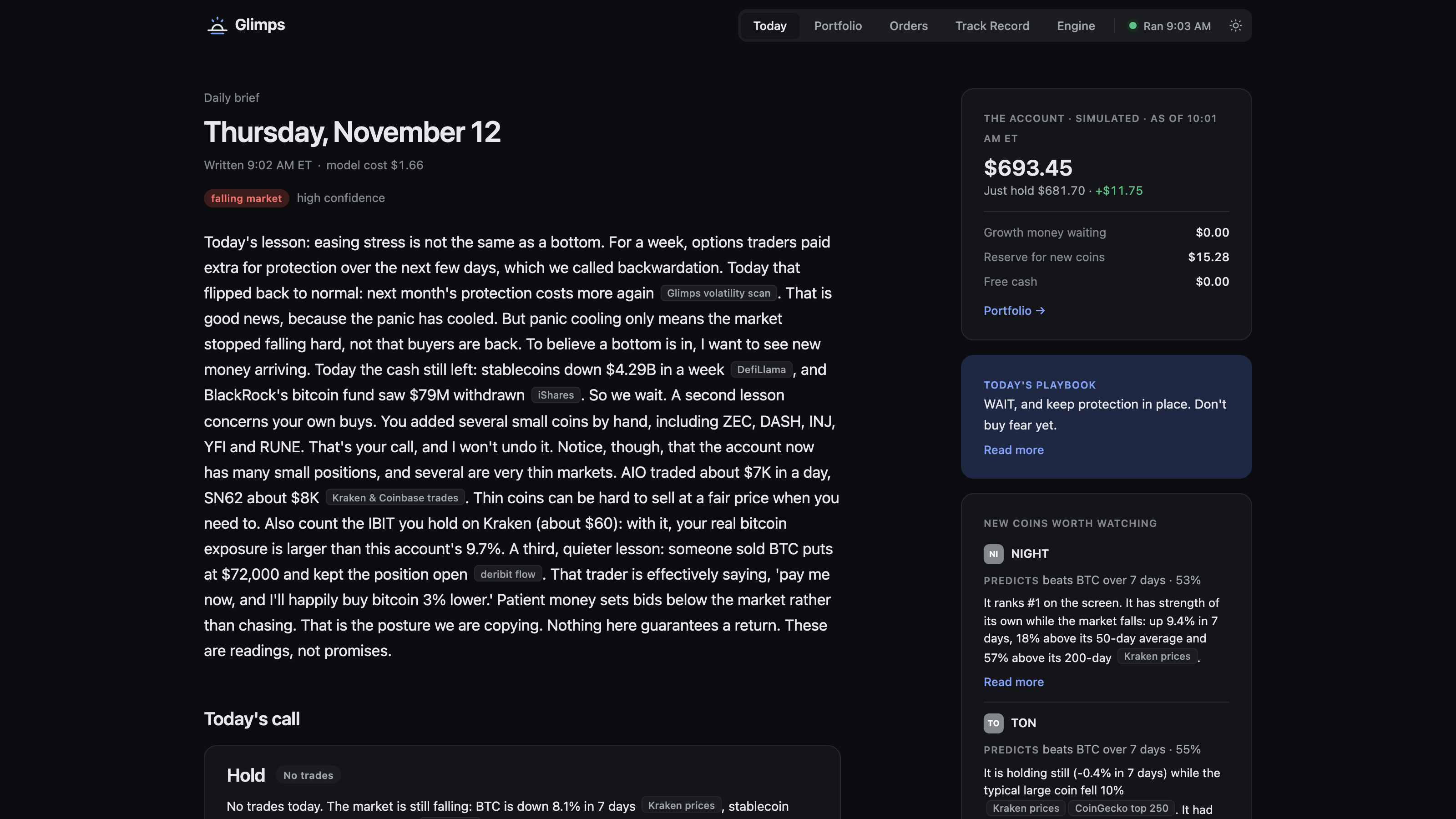
The Glimps Today tab in dark mode: the daily brief for Thursday, November 12, tagged falling market, with the day's lesson, the simulated account at $693.45 beside just hold, today's playbook, new coins worth watching and the start of today's call: hold, no trades.
The daily brief: what moved, why, and what the model decided, with each claim tied to the evidence behind it.
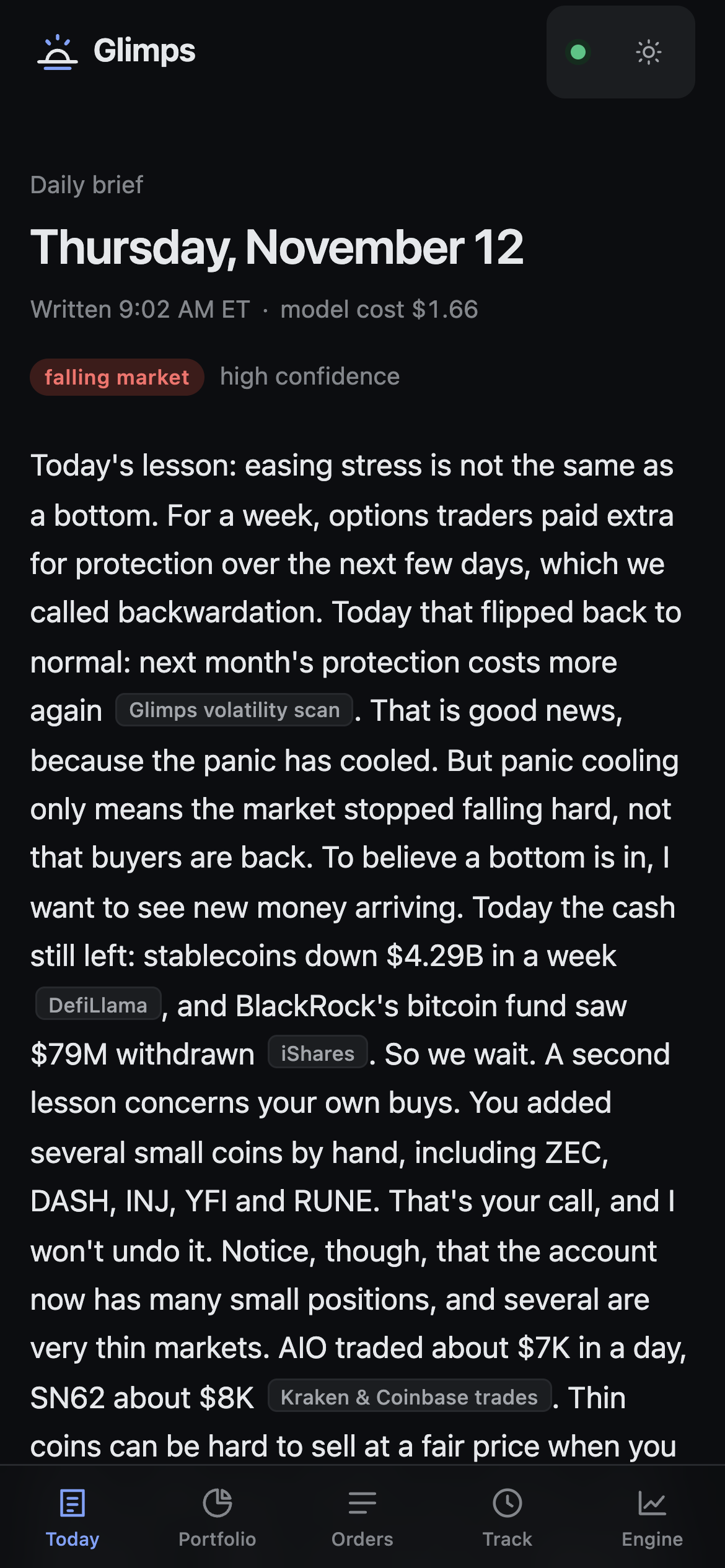
The Glimps Today tab on a phone in dark mode: the daily brief for Thursday, November 12, tagged falling market, with the tabs in a bar along the bottom.
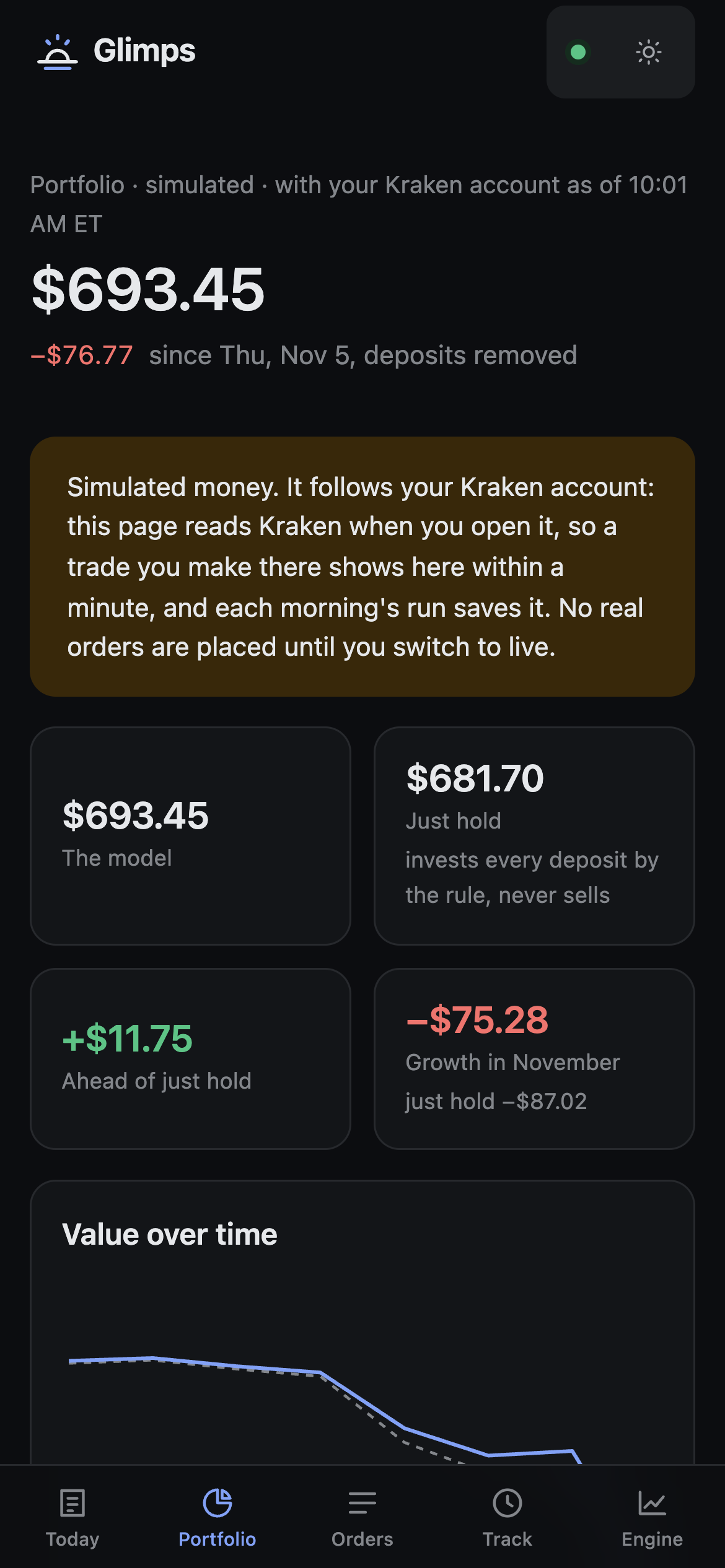
The Glimps Portfolio tab on a phone in dark mode: the simulated account at $693.45, with the Kraken account as of 10:01 AM ET, a notice that it follows the Kraken account and that no real orders are placed until the switch to live, the model at $693.45 against just hold at $681.70, and the start of the value-over-time chart.
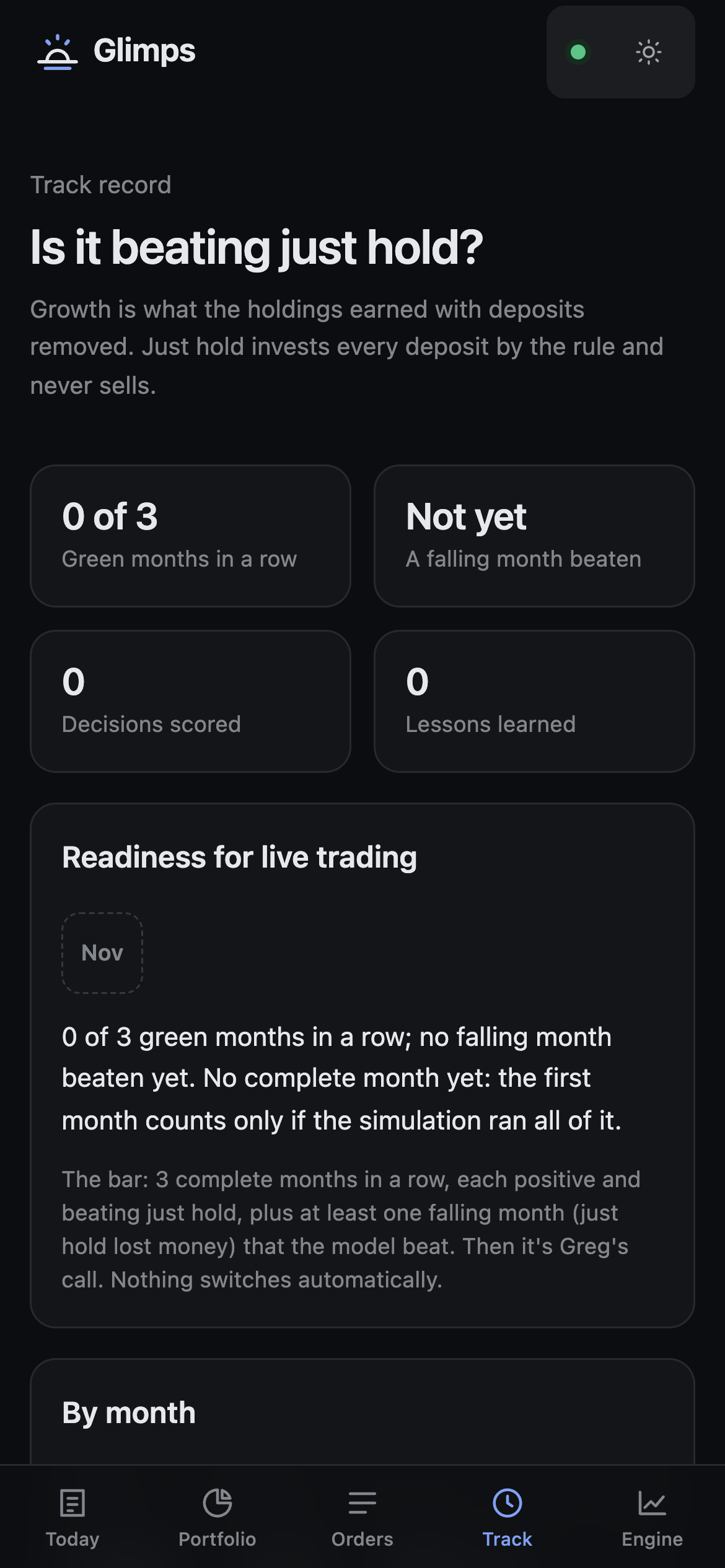
The Glimps Track Record tab on a phone in dark mode: is it beating just hold, 0 of 3 green months in a row, no falling month beaten yet, and the readiness bar for live trading.
On a phone: the daily brief, the account against just hold, and the track record toward the go‑live bar.
01

Problem framing

I’m a retail investor, not a trader, and I wanted to understand the market rather than be told about it. Most tools hand you a conclusion with no way back to the evidence, and the better they sound, the harder they are to check. Here, a wrong input costs real money.

So Glimps is an information-quality product first. If the information is corrupt, everything built on it is corrupt; there is no slightly wrong. A twelve-principle charter holds that line, and it wins over speed and convenience every time.

And the question comes before the money. Whether the system has an edge can be answered without a single live order, so none is placed until it is.

The problem: most tools hand over a conclusion with no way back to the evidence, and a strategy that sounds right is usually tested with real money. 1 · Conclusions without evidence Market dataprices, flows, news A tool’s conclusionsounds sure, can’t be checked You act on itreal money on the line no source no source 2 · Edge tested with real money A strategy sounds righta good story, no record Trade it liveno benchmark to beat Learn with real moneythe costly way The goal: every claim traceable to its evidence, and an edge proven in simulation before any money moves.
Two failures, one goal. Dashed: where the source drops out. The solution answers both rows.
02

Research as evidence

Research isn’t a phase here; it’s what the system runs on. Evidence comes only from a vetted list of free public sources, and each reading is stored with its source and the time the event happened, so lag is visible. No data beats unattributed data. The evidence can’t be edited or deleted, the model never writes to it, and every order has to cite a reading by its id.

The harder part was keeping the system honest about itself:

  • A fair benchmark. The account is measured against just hold: the same money doing nothing but investing deposits by a fixed rule. An earlier alpha number was retired when I saw it flattering the system.
  • Every decision scored. Each order is scored at seven, thirty and ninety days against not making it, and so is money left waiting, so holding back has a cost on the record.
  • Screen versus model. Code ranks every coin on nine signals before the model sees anything, and that ranking is scored too, so I can tell which one adds the value.
  • The real account, not a copy. I kept trading by hand, and the simulator was working from a copy made on day one, so the brief was planning around cash I’d already spent. Now every run reads the exchange first and applies my trades to both sides of the comparison, so they count for neither.
  • Earned confidence. Every prediction carries a probability that is scored when its horizon passes, and each brief says what the day’s evidence doesn’t cover.
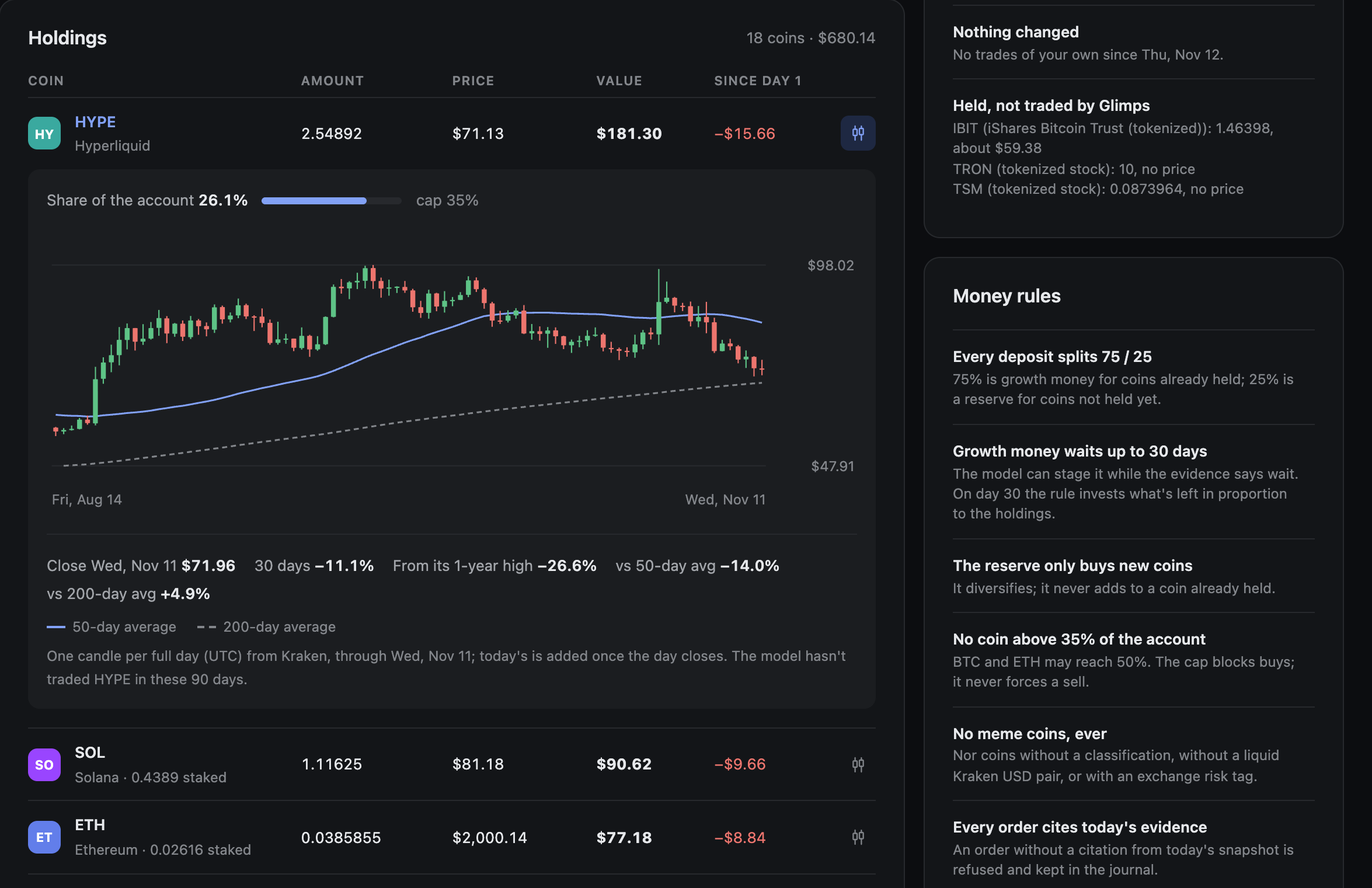
The Glimps Portfolio tab in dark mode with the HYPE holding opened, the first of 18 coins: its 26.1% share of the account against a 35% cap, ninety days of daily candles from Kraken through Wednesday, November 11 with the 50-day and 200-day averages, and beside the holdings the end of the Your Kraken account card and the money rules.
Each holding opens to ninety days of Kraken candles, its 50- and 200-day averages, and its share of the account against the cap, with the money rules beside it in plain language.
03

Solution as a system

Glimps is a daily loop with a check at every joint. Evidence is gathered and frozen, code ranks the coins, the model writes the brief and decides buy, sell or hold, and hard rules in code have to pass before anything fills in a simulator that follows the real Kraken account, hand trades included.

Security is part of the design. Custody stays at the exchange, with withdrawals disabled on every key at the exchange itself, not in my code. The server answers only on the machine it runs on and asks for a sign-in, secrets never enter version control, and the runtime depends on five pinned packages.

Live money is a gate, not a date. The switch stays locked until the simulation beats just hold three months in a row and beats at least one falling month, and even then I flip it by hand. Once live, trading halts on its own if the account trails just hold too far in a month, and any order with an unknown outcome stops everything until it’s resolved.

Glimps daily loop: sources to upkeep to gather to an immutable evidence snapshot to the screen on top; teach and decide to check to execute to remember to the track record beneath; weekly lessons, the spot tape, and custody at the base. Information Purity Charter · vetted sources · provenance or nothing · immutable evidence · versioned prompts SourcesKraken, Coinbase, Deribit,ETFs, FRED · vetted, free Upkeep08:15 · ledger, fees,key check, coin universe Gather08:45 · the day's readingsfrom every source Evidence snapshotimmutable · every readinghas an id to cite Screencode ranks every coinnine signals, no model Evidence · gathered once, each morning (New York time) 09:00 Track recordagainst just holdthe number that counts Rememberevery order, at 7, 30, 90days against not acting Executesimulator follows Krakenlive switch stays locked Checkrules in code · size caps,no meme coins, cited ids Teach, then decideOpus 5.5 writes the brief,then buy, sell or hold Decisions · once a day Learnevery Sunday, lessons from the scoresfeed the next briefs and the screen's weights Spot tapeevery 30 minuteswhale prints, into Gather Custody and surfacecustody at Kraken, no key can withdrawloopback only · sign-in · five pinned packages Code ranks and checks; the model teaches and decides; both are scored. Nothing goes live until the track record earns it.
Evidence flows left to right each morning; the decision flows back at 9:00. Code ranks and checks, the model teaches and decides, and the track record decides whether anything goes live.
04

Takeaway

Information quality beats speed. The slower, auditable pipeline makes decisions I can defend and, more importantly, prove wrong. Without provenance, it’s just vibes.

The edge isn’t demonstrated yet. The benchmark is hard to beat on purpose, and the record needs more than one kind of market before it means anything. Glimps has run on a Mac mini since September, and the current simulation began in November. Building a system whose main answer might be “don’t do this” was the point.

Using it found what the tests hadn’t. The brief was describing an account I no longer had, and one long brief came back with its lesson blank. Both were fixed the day they showed, and each now has a check of its own.
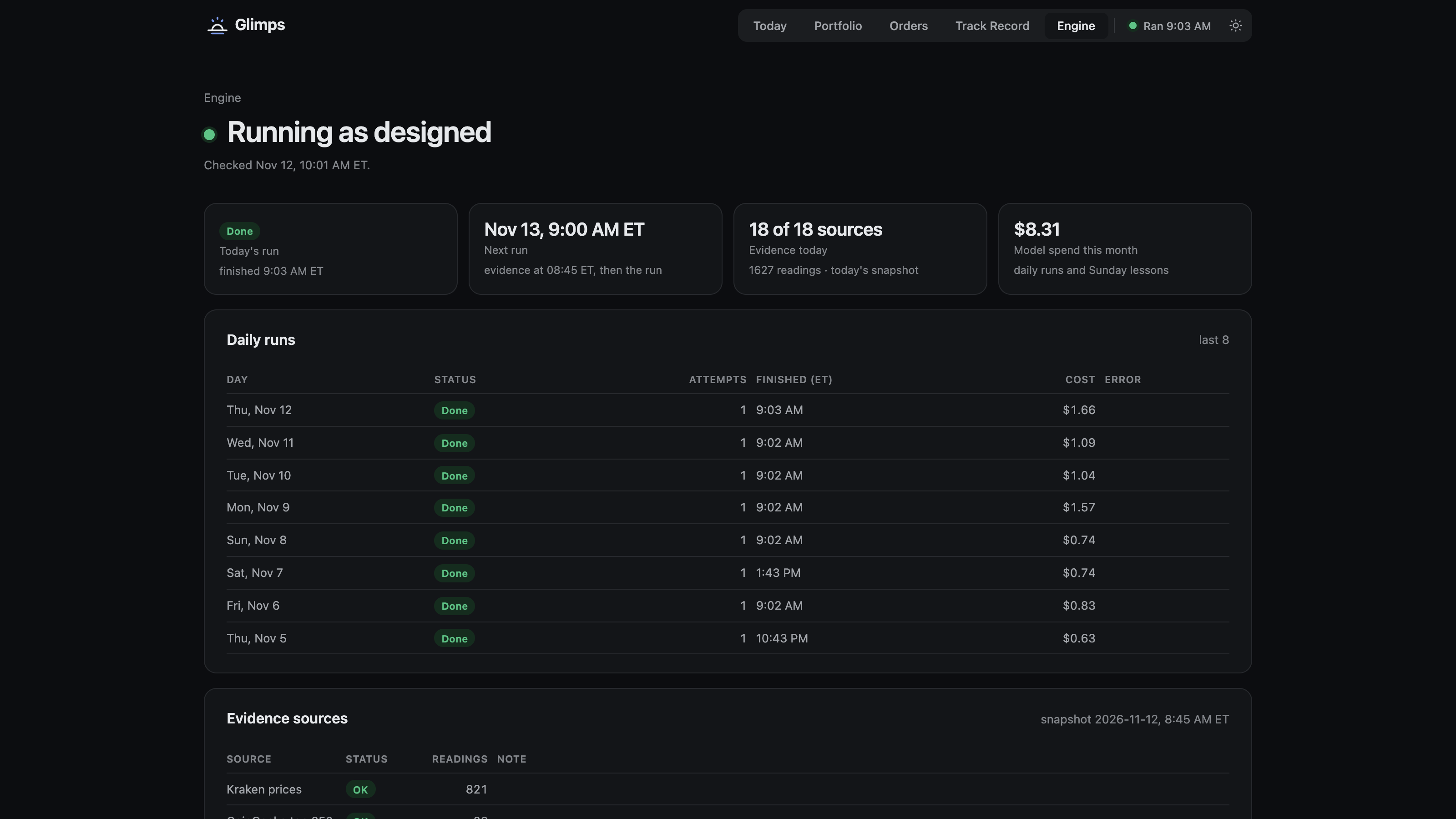
The Glimps Engine tab in dark mode: Running as designed, checked November 12, today's run done, 18 of 18 evidence sources, and the last eight daily runs each finished on the first attempt.
The Engine tab: every scheduled run and evidence source, green or red with the reason. The track record replaces it once a full month is in.